Blackwood property trespassing rule
We Have Always Lived in the CastleThe Blackwood property trespassing rule governs who may cross the Blackwood land and by which route. Its paired gates, padlocks, and PRIVATE NO TRESPASSING signs turn a former village shortcut into a forbidden path, while the main drive reserves access for invited visitors. In Mary Katherine Blackwood’s account, the rule is not merely a property boundary: it gives physical form to the Blackwoods’ distance from the Village and to her own sense that the locked threshold makes home safe.
Establishment and Layout
The restriction began when Mary Katherine’s father closed the path that had connected the Village with the highway four-corners, where the bus stopped. Using the path saved travelers perhaps a quarter of a mile, but it also took them past the Blackwood front door. After bringing his wife to live in the Blackwood house, her father fenced the property from the highway to the creek and closed the route. The mother’s stated objection drew a sharp distinction between a public highway and a private front door: “The highway’s built for common people,” she said, “and my front door is private.”
The rule is secured at both ends of the path. At the gate Mary Katherine uses, a simple padlock holds a sign declaring that entry is forbidden; another gate farther along carries the same warning and is also locked. The barrier is materially modest—the first lock, she observes, could have been broken by a child—but the sign gives the boundary an explicit claim of authority. The Blackwood estate fence and gates thus work together: the fence encloses the land, while the locked entrances mark the specific points at which passage is denied.
The family’s other approach clarifies that the rule does not exclude every outsider indiscriminately. Properly invited visitors are directed up the main drive from the gateposts on the highway to the front door. The division is therefore between authorized arrival by the drive and unauthorized passage along the path, not simply between people inside and outside the estate.
Access and Social Distinction
Mary Katherine imagines the two routes as opposing streams. In her childhood picture of the house, the driveway is a crossroads before the front door: the clean, rich visitors in satin and lace travel up it, while Village people move along the path, sneaking and sidestepping. The scene is her imagined social arrangement, not evidence that invited callers literally dressed or behaved that way. But the contrast shows how she understands the rule: the drive makes welcome visible, and the locked path keeps the people she associates with the Village from approaching on their own terms.
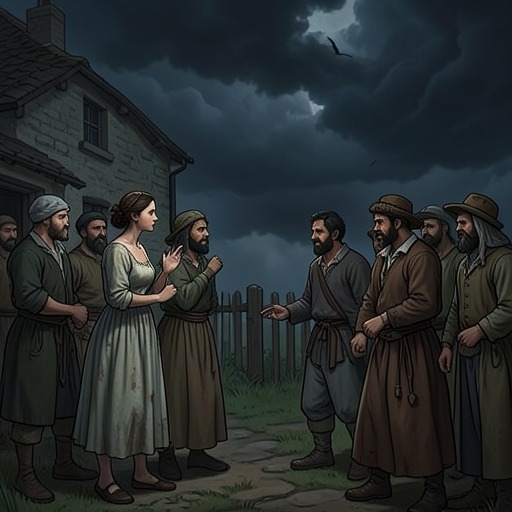
That private boundary sits within a wider local geography of unequal wealth and influence. People such as the Clarkes and Carringtons live in newer homes beyond the Village, while the Blackwoods own the land between the highway and the river. The villagers nevertheless pass the Blackwood property on their daily routes, and the Blackwood Road circles the family land behind a wire fence built by Mary Katherine’s father. Against this background, the closed path is one concrete expression of a broader division between the estate and the community around it. Mary Katherine says the people of the Village have always hated the Blackwoods; the locks do not create that hostility, but they make separation part of the landscape.
Operation in Mary Katherine’s Daily Life
The rule shapes Mary Katherine’s return from shopping. At the black rock, she puts down her bag, unlocks the gate, carries the shopping through, and locks the gate again behind her. She tests the padlock to make sure it holds. That small repeated check turns the prohibition into a personal routine: crossing into the property is followed by securing the boundary, and security is confirmed by the lock’s resistance.
Once inside, she describes the path as dark and familiar. Her father had let trees, bushes, and flowers grow as they chose after abandoning the idea of putting the land to profitable use; apart from a meadow and the gardens, the property is heavily wooded. Mary Katherine knows the path’s turns and steps, and regards its less-traveled ways as refuges. She says the only prints on the path are her own going to and from the Village, though Constance Blackwood sometimes comes as far as a turn to wait for her. The rule therefore does more than keep others out: it helps define a private route that Mary Katherine alone regularly traverses, with Constance’s occasional presence marking a limited point of contact between the house and the gate.
Meaning and Limits
The rule’s force combines a physical obstacle with a belief about who belongs. Its lock is easy to break, yet Mary Katherine recalls that no one from the Village had tried to use the path since her father closed the gates. The account does not establish that the sign could legally prevent entry or that the lock was unbreakable; its effectiveness in her experience rests instead on the marked prohibition, the enclosing fence, and the family’s separation from the Village.
For Mary Katherine, the boundary also organizes an inward sense of safety. She repeatedly imagines that the villagers cannot get in because the path is closed forever, and after fastening the padlock she feels safe. The rule consequently operates at once as household policy, social demarcation, and a ritual of reassurance. Its central tension is that the path remains physically near the highway and once served ordinary travelers, yet the signs and locks recast that familiar passage as private ground. The family’s home is protected not by distance alone, but by controlling the terms on which anyone may approach it.